

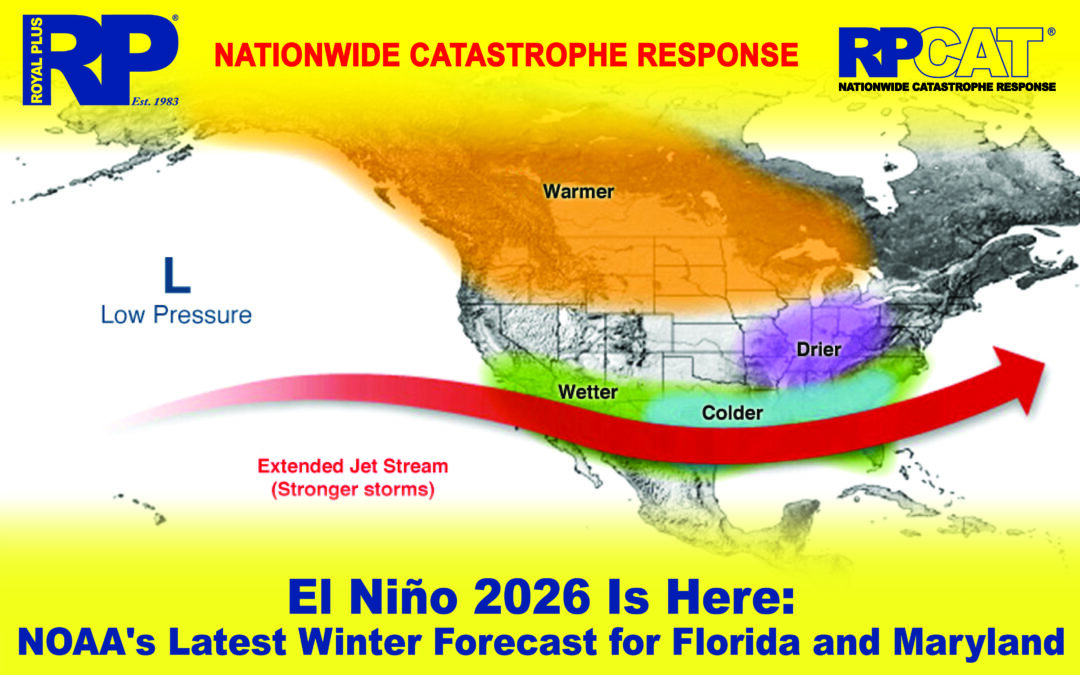
El Niño is officially underway, and NOAA is forecasting a potentially historic winter weather pattern for 2026–2027. Florida and Maryland are among the states where changes in rainfall, storm tracks, and seasonal weather could have significant implications for businesses and commercial properties.
The National Oceanic and Atmospheric Administration (NOAA) confirmed that El Niño developed in June 2026. Since then, ocean temperatures in the equatorial Pacific have continued to climb, and atmospheric conditions have become increasingly consistent with a strengthening El Niño.
According to NOAA’s latest El Niño advisory, issued September 10, 2026, there is a greater than 90% probability that this event will reach very strong intensity during fall and winter 2026–2027. Forecasters also estimate a 75% chance of an event exceeding the strength of previous El Niño events in the historical record dating to 1950.
These are not predictions about whether El Niño will develop. El Niño is already occurring. The remaining uncertainty involves how strong it will become and exactly how it will influence regional weather.
What NOAA Is Predicting Right Now
NOAA’s September 17, 2026 seasonal outlook identifies an increased likelihood of above-normal precipitation across much of the Southeast and Mid-Atlantic.
Florida: The outlook favors wetter-than-normal conditions, particularly across northern Florida and portions of the Southeast. As the winter progresses, Florida could experience more frequent frontal systems, periods of heavy rainfall, and an increased opportunity for severe thunderstorms. The strongest seasonal precipitation signal is not a prediction that every month or every community will be unusually wet.
Maryland: NOAA also favors increased precipitation across portions of the Mid-Atlantic. This raises questions about how many coastal storms could affect Maryland during winter 2026–2027 and whether those systems will produce rain, snow, freezing rain, or mixed precipitation.
Unlike rainfall outlooks, seasonal snowfall predictions remain especially uncertain. Significant snowfall requires both a favorable storm track and sufficiently cold air.
<BR>
Florida Winter 2026–2027:
What Businesses Should Expect
For Florida, the primary El Niño-related concerns are increased precipitation, severe thunderstorms, localized flooding, and water intrusion.
During winter, a more active southern jet stream can steer storm systems across the Gulf Coast and Florida Peninsula.
This is especially relevant for commercial properties in Jacksonville, Orlando, Winter Springs, and throughout Central and Northeast Florida.
Heavy rainfall can overwhelm drainage systems, expose existing roofing vulnerabilities, and introduce moisture into occupied buildings. Strong thunderstorms can also produce damaging winds and occasionally tornadoes.
NOAA’s forecast favors wetter conditions, but it does not predict exact rainfall totals, tornado counts, or the timing of individual storms months in advance.
<BR>
Maryland Winter 2026–2027:
What About Snow and Nor’easters?
Maryland faces a different combination of winter weather concerns.
An active El Niño storm track can increase opportunities for precipitation across the Mid-Atlantic, including coastal low-pressure systems.
For Maryland, an important factor will be whether cold air is in place when these systems develop.
A coastal storm affecting Ocean City, Salisbury, Berlin, Snow Hill, Baltimore, or surrounding communities could bring heavy rainfall, snow, or mixed precipitation depending on temperatures and storm positioning.
Maryland’s Eastern Shore also remains vulnerable to tidal flooding and strong coastal winds during winter storm events.
Although El Niño can influence storm patterns, NOAA has not established a reliable statewide snowfall total for Maryland for winter 2026–2027.
Commercial property owners should therefore prepare for multiple possibilities: periods of heavy rain, isolated significant winter storms, freezing temperatures, and potential coastal flooding.
<BR>
Why the 2026–2027 Winter Forecast Matters for Commercial Properties
The emerging weather pattern highlights the importance of seasonal maintenance and emergency planning.
Businesses, healthcare facilities, schools, municipalities, hotels, warehouses, and other commercial properties should review roof conditions, drainage systems, exposed plumbing, and emergency response procedures before winter.
For Florida facilities, special attention should be given to rainfall-related water intrusion, storm drainage, and severe-weather preparedness.
For Maryland facilities, preparation should also address freezing pipes, snow and ice conditions, and coastal storm exposure.
Royal Plus has provided disaster recovery and property restoration services for more than 40 years. Our teams support commercial property owners with emergency water mitigation, structural drying, storm damage cleanup, and reconstruction services.
As NOAA continues updating its winter predictions, Royal Plus encourages property owners and facility managers to follow local National Weather Service guidance and review their property’s vulnerabilities ahead of severe weather.
<BR>
For commercial restoration and emergency disaster recovery services, visit www.royalplus.com or call (866) 404-7587.
Recent Comments